 Sunday, May 10, 2026
We had booked the Lumière package at one of the hotels on the Biltmore Estate. Although I had read all of the emails carefully, I still found myself confused about whether we were allowed to access the estate before checking in, and whether we could stay on the estate after checking out.
As we approached the main gate, there were signs saying that we had to have tickets before entering. We stopped at the visitor center, only to be told that we simply needed to tell the guy at the main gate that we were staying at the hotel, and he would give us our pass. Yes, we could access the estate before and after our official check-in and check-out times. However, if we wanted to return on other days, we would have to pay the regular entrance fees.
We found our hotel, checked in, and then immediately headed out to explore. I asked the front desk agent about the trolleys, and she explained that we could either take the trolley or drive ourselves. The main difference was that with the trolley, we would have to wait for the next one. With driving, we could go where we wanted, when we wanted, but we would probably end up doing more walking.
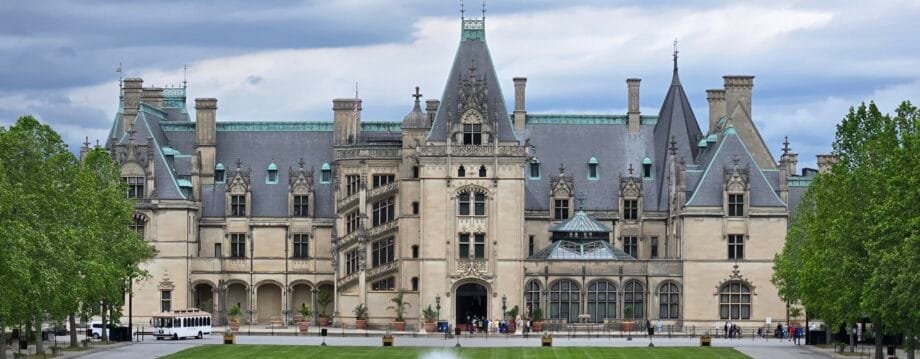
After dropping our things off in the room, we headed out. We did a complete loop around the estate and then circled back to park near the main house and adjacent gardens. We would tour the inside of the house the following day.
Before visiting the Biltmore, I had done some research. It was built by George Washington Vanderbilt II during the Gilded Age in the late 1800s. The main house has more than 250 rooms and originally sat on 125,000 acres of land. George had inherited his money from the Vanderbilt family fortune, much of which came from railroads and shipping.
It must have taken an army of people to build the place. Frederick Law Olmsted, the same man who designed Central Park in New York City, was brought in to landscape the grounds. Once it was built, the number of staff required to maintain the property must have been extensive.
Yet unlike Hearst Castle, which was donated to the state of California, the Biltmore House remains privately owned by the descendants of George Vanderbilt. It was, and still is, the largest privately owned home in the United States.
As hard as I tried to imagine that sort of wealth and what life must have been like living there, I couldn’t.


Recent Comments